Estimating the Impact of Depressional Storage Drainage on the Hydrology of a Canadian Prairie Basin using Physically Based Modelling
Estimating the Impact of Depressional Storage Drainage on the Hydrology of a Canadian Prairie Basin using Physically Based Modelling
Previously Published Material: Some of these findings were reported in Centre for Hydrology Report No. 14: Pomeroy J.W., Shook K., Fang X., Dumanski S., Westbrook C. and Brown T. Improving and Testing the Prairie Hydrological Model at Smith Creek Research Basin (2014). Some of these findings have been reported in the media: Globe and Mail, CBC The National, CBC The Current, Winnipeg Free Press, Regina Leader Post, CTV National News, PostMedia News.
Abstract ID#: 36653
English Abstract:
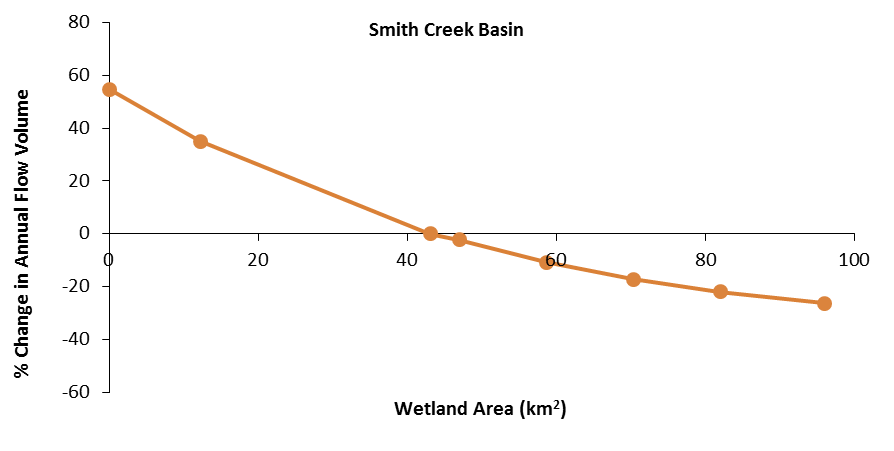
The impact of depressional storage change on the hydrology of small Canadian Prairie basins has been unclear because of conflicting conclusions on the degree of impact between studies of runoff in very small scale drainage systems and those of multi-year streamflow characteristics of larger basins. To better understand and predict the impact of depressional storage drainage (DSD) on prairie streams, the Cold Regions Hydrological Modelling platform was used to create the Prairie Hydrological Model (PHM) which simulates blowing snow redistribution, snowmelt, infiltration to frozen soils and the fill and spill of networks of ponds at multiple scales. The PHM was used to simulate the hydrology of Smith Creek Research Basin, Saskatchewan (~400 km2) with various DSD scenarios. Smith Creek basin has undergone substantial DSD from 1958 when it contained 96 km2 of ponds covering 24% of the basin area to 43 km2 covering 11% of the basin in 2008. This model simulations show that DSD can increase annual and peak daily flows substantially, and that notable increases to estimates of the annual volume and peak daily flow of the flood of record have derived from DSD to date and will proceed with further DSD. Restoration of depressional storage from the current extent back to that of 1958 decreased the simulated 2011 flood peak by 32% and the 2011 yearly volume of streamflow by 29%. Overall, Smith Creek total flow volumes over six simulation years increased by 55% due to complete DSD from the current (2008) state, and decreased by 26% with restoration to the 1958 state. Whilst the greatest proportional impacts on the peak daily flows are for dry years, substantial impacts on the peak daily discharge of record (2011) from DSD (+78%) or restoration (-32%) are notable and important in Smith Creek and downstream.